Schriftgröße
100%


Funding Body: | Ministerium für Wirtschaft, Tourismus, Landwirtschaft und Forsten des Landes Sachsen-Anhalt - Fischereiabgabe |
Project Term: | 2026 - 2028 |
What it is about: | Study of the Distribution of the Volga Zander (Volga River Pikeperch) in Germany and its competition for food with perch and zander |
Project Partner: | n/a |
Liaison IfB: | Dr Sven Matern and Steffen Zahn + 49 (0)33201/ 406 -69 (Matern) or -18 (Zahn) Email: , |
The natural range of the Volga zander, or Volga pikeperch (Sander volgensis) includes the northern parts of the Black Sea and Caspian Sea drainage basins. Since 2010, Volga zander have also been caught by anglers outside their natural range, primarily in the Mittelland Kanal between Hannover and Wolfsburg. The Volga zander has now apparently spread along the entire length of the Mittelland Kanal and the Elbe-Havel Kanal in Lower Saxony, Saxony-Anhalt, and Brandenburg. The Volga zander resembles the native zander (Sander lucioperca) and represents an interesting target species for recreational fishing. The project aims to investigate the current distribution of the Volga zander in Germany, as well as its competition for food with native fish species. Additionally, the project seeks to conduct analyses of growth and sexual maturation in comparison to the native zander.
At first glance, the Volga zander (Volga pikeperch) looks like a cross between a zander (Sander lucioperca, or pikeperch) and a perch (Perca fluviatilis). There are a total of 11 characteristics that make it easy to distinguish between the zander and the Volga zander. The simplest characteristic for a reliable identification is the absence of the so-called ‘canine teeth’ in the Volga pikeperch compared to the pikeperch. Other easily recognisable characteristics include the pronounced and distinct transverse stripe pattern on the Volga pikeperch and its smaller maximum size (rarely >60 cm, compared to the pikeperch’s >100 cm). These characteristics are entirely sufficient for a reliable identification. Further distinguishing criteria include body shape, the shape of the dorsal fin, the position of the intermaxilla, the shape of the snout, the scaling of the gill cover, eye diameter, and the size and number of scales along the lateral line.
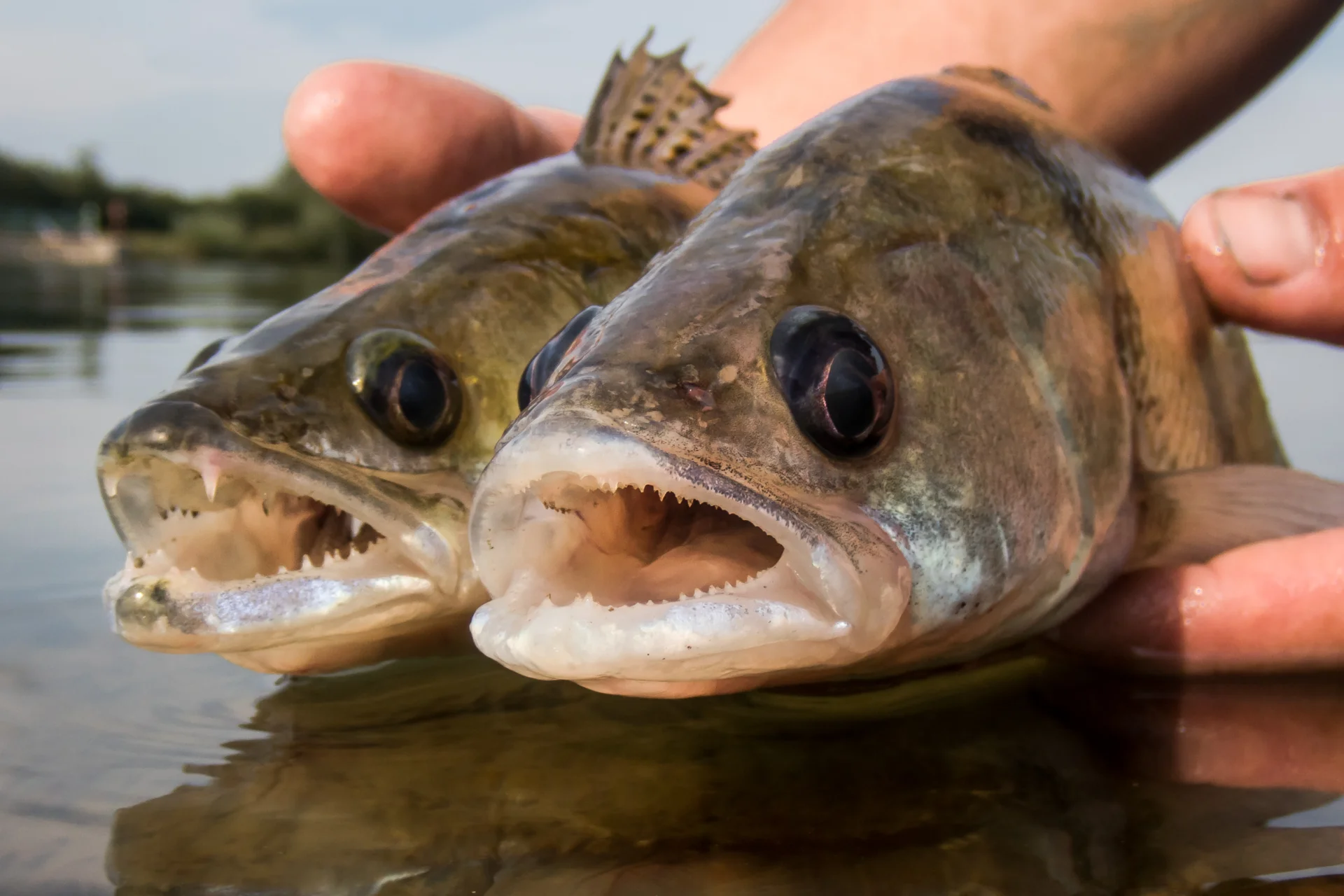
Figure 1: In comparison to the native Zander (Sander lucioperca, left) is the Volga Zander (Sander volgensis, right) lacking the so-called 'canine teeth' (Photo, with permission: © Matthias Emmrich)
In general, the Volga zander is more tolerant of low oxygen levels than the zander. Unlike the zander, the Volga zander does not tend to its young and spawns later than the zander, meaning that natural hybridisation is rather rare. Scientific literature proposes that the Volga zander’s lack of brood care may also be the reason why, when it coexists with the zander in the same body of water, its population density is consistently lower.
For a more comprehensive species profile follow the link.
